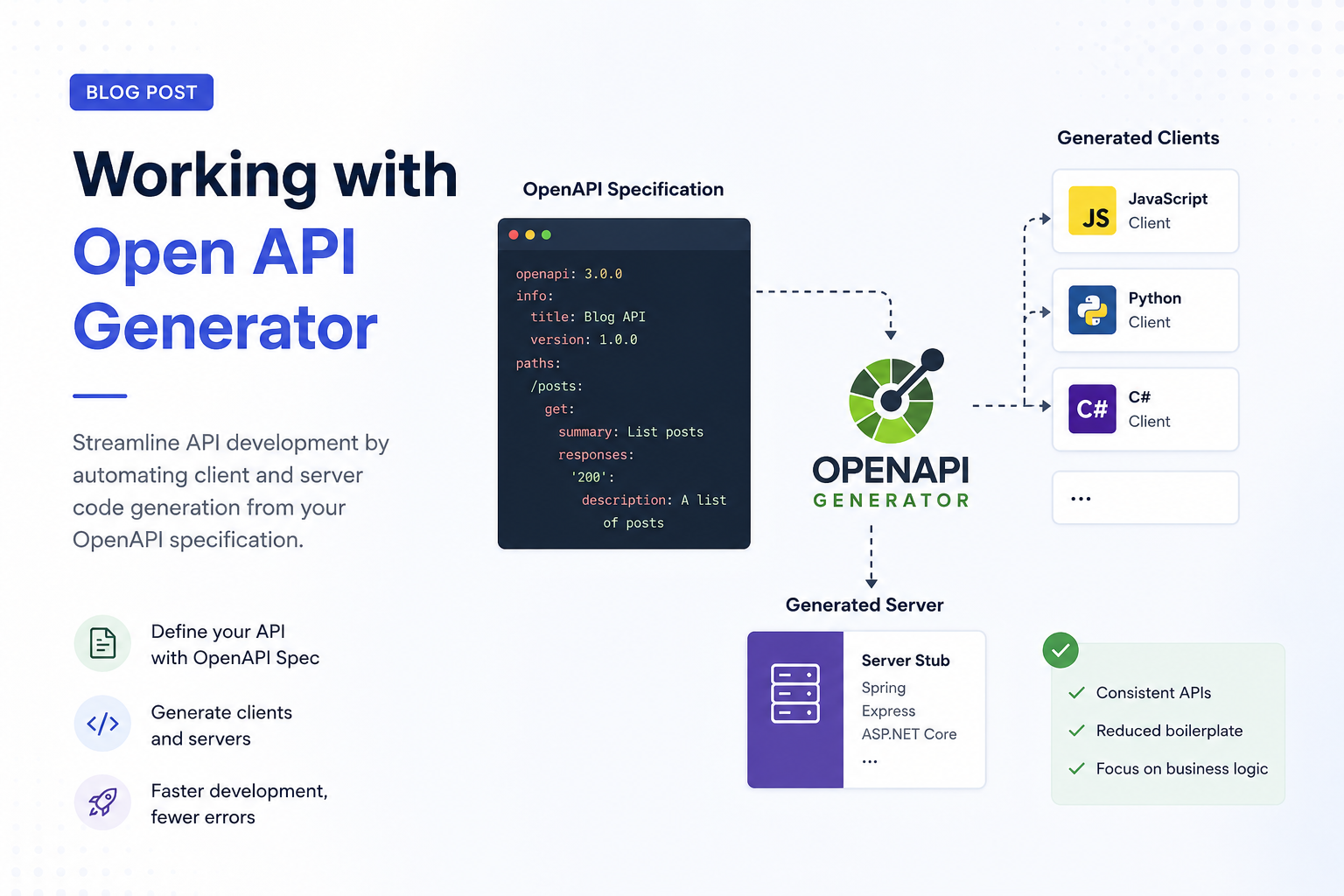
Using OpenAPI Generator for Model Generation in iOS Apps
Intro
Most iOS projects start the same way:
You create a few Codable structs manually, add a networking layer, and move on.
Then the backend grows.
Endpoints multiply.
Models become inconsistent.
The backend changes field names.
Someone forgets to update a DTO.
Suddenly your app contains hundreds of manually maintained models.
This is where OpenAPI Generator becomes valuable.
Instead of manually writing and maintaining API models, you generate them directly from the backend OpenAPI schema.
In this article, I’ll explain:
- how OpenAPI Generator works,
- how to integrate it into an iOS project,
- the architectural tradeoffs,
- and the mistakes to avoid if you want a maintainable setup.
What is OpenAPI Generator?
OpenAPI Generator is a tool that generates API clients and models from an OpenAPI specification.
The backend exposes a schema file (openapi.json or swagger.yaml), and the generator creates:
- request models,
- response models,
- API clients,
- enums,
- serializers,
- and networking abstractions.
For iOS projects, this means you can generate Swift Codable models automatically instead of writing them by hand.
Official website:
Why This Matters in Real Projects
The biggest benefit is not speed.
It’s consistency.
When your backend evolves:
- new fields appear,
- enums change,
- nullable values change,
- contracts evolve.
If your models are generated:
- the app stays aligned with backend contracts,
- integration bugs decrease,
- and API changes become visible immediately during generation.
This becomes especially important in:
- banking apps,
- enterprise apps,
- large teams,
- multi-platform environments,
- and microservice-heavy architectures.
Installation
The easiest way is via Homebrew:
brew install openapi-generator
Verify installation:
openapi-generator version
Generating Swift Models
Assume your backend provides:
openapi.yaml
You can generate Swift code like this:
openapi-generator generate \
  -i openapi.yaml \
  -g swift5 \
  -o GeneratedAPI
This generates:
- models,
- API clients,
- request builders,
- serializers,
- and supporting files.
Recommended Architecture
This is where many teams make mistakes.
Do NOT directly use generated models across your entire app.
Generated code is infrastructure code.
Treat it as external.
A cleaner architecture looks like this:
Presentation Layer
        ↓
Domain Models
        ↓
Mapper Layer
        ↓
Generated API Models
        ↓
Networking
Why?
Because generated code changes frequently.
If your UI depends directly on generated DTOs:
- backend changes leak everywhere,
- refactors become painful,
- and your app architecture becomes tightly coupled to the API contract.
Generated models should remain isolated behind mapping layers.
This is one of the most important architectural decisions in long-term iOS projects.
Example
Generated model:
public struct UserResponse: Codable {
    public let id: Int?
    public let firstName: String?
    public let lastName: String?
}
Domain model:
struct User {
    let id: Int
    let fullName: String
}
Mapper:
extension User {
    init(dto: UserResponse) {
        self.id = dto.id ?? 0
        self.fullName = "\(dto.firstName ?? "") \(dto.lastName ?? "")"
    }
}
This keeps your app stable even if the API evolves.
Common Problems
1. Nullable Hell
Many OpenAPI schemas overuse nullable fields.
You end up with:
String?
Int?
Bool?
everywhere.
This is not a Swift problem.
It’s usually a backend schema quality problem.
Generated code exposes backend contract quality brutally fast.
2. Regeneration Conflicts
If developers manually edit generated files, regeneration becomes dangerous.
Rule:
Never modify generated code manually.
Instead:
- customize templates,
- use wrappers,
- or use extensions.
3. Massive Generated Codebases
Large APIs can generate thousands of files.
Do not dump everything into the main target.
Use:
- separate Swift packages,
- modules,
- or isolated folders.
Treat generated code as dependency code.
CI/CD Integration
One underrated advantage:
You can automate generation during CI.
This allows:
- schema validation,
- API compatibility checks,
- early detection of breaking changes.
Some teams even fail pull requests if the generated code changes unexpectedly.
That’s powerful.
Should You Generate the Entire API Client?
Usually: no.
For many iOS apps, generating only models is the sweet spot.
Why?
Because networking layers are often highly customized:
- authentication,
- retry policies,
- logging,
- caching,
- interceptors,
- async/await integration.
Many generated networking clients feel rigid.
A common approach is:
- generate models,
- keep custom networking.
That gives you flexibility without manual DTO maintenance.
Final Thoughts
OpenAPI Generator is not just a code-generation tool.
It’s a contract-enforcement tool.
Used correctly, it:
- improves consistency,
- reduces integration bugs,
- accelerates backend/frontend collaboration,
- and makes large iOS codebases easier to maintain.
Used incorrectly, it creates:
- tightly coupled architectures,
- unreadable generated layers,
- and dependency chaos.
The key is separation:
- generated DTOs stay in infrastructure,
- domain models stay clean,
- and mapping layers protect the app from backend volatility.
That separation is what makes the approach scalable.